
South Okanagan Real Estate Market Update: Week Ending February 7, 2026
South Okanagan Real Estate Market Update: Week Ending February 7, 2026
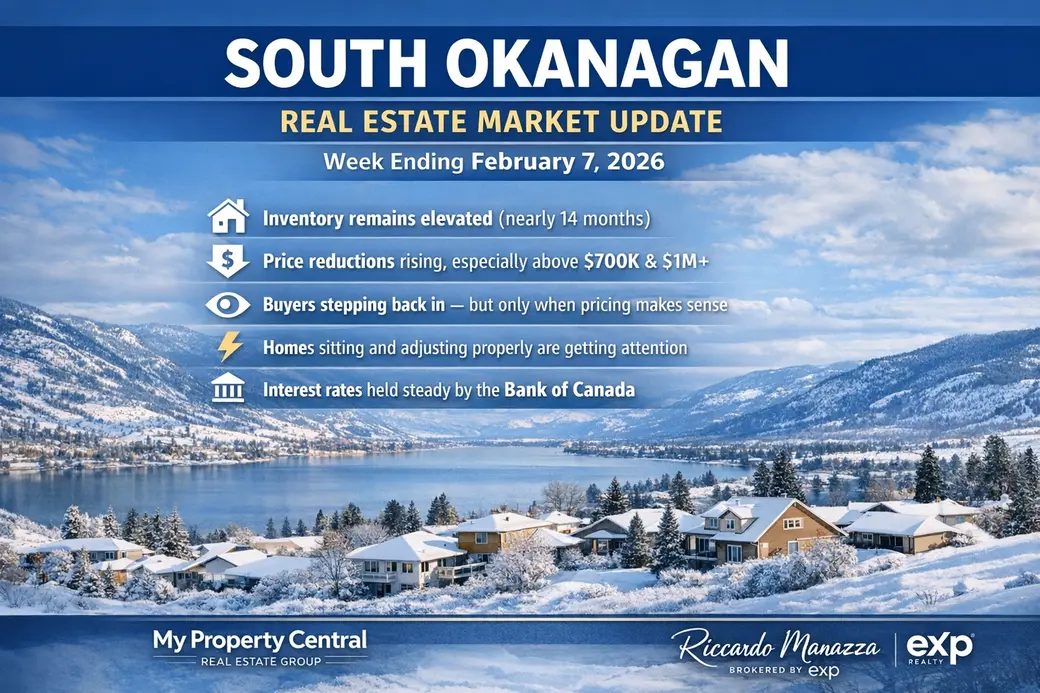
The South Okanagan housing market just experienced one of its most telling weeks in months. With 125 new listings hitting the market against just 24 firm sales, inventory surged to 1,446 active listings and pushed months of inventory to approximately 14.0 months—well into buyer-leaning territory.
This isn't just another data point. It's a clear signal that market dynamics are shifting decisively in favor of buyers, and sellers who aren't paying attention to pricing and presentation are facing longer days on market and tougher negotiations. At the same time, national forecasts from CREA and provincial trends from Vancouver and Victoria paint a picture of cautious optimism: pent-up demand is real, but buyers are selective, deliberate, and waiting for the right opportunity.
So what does this mean for you—whether you're thinking about buying your first home, moving up, downsizing, or simply trying to understand where the market is headed? Let's break down the national context, the BC regional signals, and then dive deep into what happened right here in the South Okanagan this past week.
Key Takeaways & Navigation
At a Glance: Week Ending February 7, 2026
- 125 new listings vs 24 firm sales—inventory expanding rapidly
- 1,446 active listings across the South Okanagan service area
- ~14 months of inventory (buyer's market threshold is 6.4+ months)
- 26 price reductions averaging ~$35,398 (excluding outliers)
- 41 listings went off-market (expired/cancelled) after avg ~220 DOM
- Average sale price: $634,676 | Median: $622,500
- Penticton led with 13 sales—still the core sales engine
- Average days on market for sales: ~110 days
National Canadian Real Estate News: What's Moving the Market
Understanding what's happening locally starts with understanding the national picture. Canada's housing market is at a fascinating inflection point—caught between pent-up demand, stabilizing interest rates, and persistent economic uncertainty.
CREA's latest forecast projects that 494,512 residential properties will trade hands via Canadian MLS® Systems in 2026, representing a 5.1% increase from 2025. The recovery is expected to be driven largely by British Columbia and Ontario, where sales have significant room to rebound. BC and Ontario are forecast to see activity rise by more than 8% in 2026, while other provinces with already-elevated sales levels and constrained supply will see more modest gains.
On the pricing front, the national average home price is forecast to rise 2.8% to $698,881 in 2026. Importantly, BC is expected to see smaller increases compared to provinces like Saskatchewan, Quebec, and Newfoundland where prices have been climbing at a faster clip. The key takeaway? Price growth is moderating across major markets, and affordability—while still challenging—is improving as rates stabilize.
A critical milestone was reached on October 29, 2025, when the Bank of Canada signaled clearly that rates were likely as low as they were going to get. While many prospective buyers had hoped for deeper cuts, rates have fallen far enough to restore attainability for a significant segment of sidelined buyers—particularly first-timers who've been shut out for the past four years. CREA Senior Economist Shaun Cathcart noted that this "green light" for fixed-rate borrowers could be the catalyst many have been waiting for.
But here's the nuance: pent-up demand doesn't mean instant recovery. Buyers are more deliberate, more risk-averse, and more focused on value than they were pre-2020. They're taking time to understand the buying process, get pre-approved, and ensure they're making the right move. This measured approach is exactly what we're seeing play out in the South Okanagan.
▲ Back to Key TakeawaysBritish Columbia Housing Trends & Regional Signals
Zooming in from the national view, BC's housing market is experiencing its own unique dynamics—and they have direct implications for what we're seeing in the South Okanagan.
Metro Vancouver is showing clear buyer-market conditions. Homes are averaging approximately 100 days on market, with inventory levels up 18% year-over-year and prices down about 4.5% year-over-year as measured by the MLS Home Price Index. December 2025 saw 1,537 home sales against 12,550 active listings—creating about 8 months of inventory, well into buyer-favorable territory.
What's particularly telling is the type of activity Vancouver is seeing: over 80% of Metro Vancouver homes sold below their final asking price in 2025. This reflects a market where negotiation is the norm, not the exception, and where buyers have both time and leverage.
Greater Victoria is following a similar pattern. Sales are down year-over-year, listings are up, and the market has transitioned into balanced-to-buyer-leaning conditions. The North Shore (North and West Vancouver) reported that sales in January 2026 were down sharply compared to last year, with inventory remaining elevated at 12% above the 10-year average.
The common thread? High inventory + selective buyers = pricing pressure and longer marketing times. Sellers who aren't responsive to market feedback are seeing their listings stagnate, while those who price competitively and present well are still getting deals done.
For the South Okanagan, these regional trends matter because they reflect broader BC buyer psychology. If Vancouver and Victoria—our province's two largest markets—are experiencing soft conditions and negotiation-heavy environments, it's unrealistic to expect the South Okanagan to operate in a vacuum of strong demand and rising prices. We're all part of the same provincial economic ecosystem, influenced by the same interest rate environment, the same employment trends, and the same consumer confidence levels.
▲ Back to Key TakeawaysMarket Data Snapshot: South Okanagan Real Estate Activity
Now let's get into the numbers that matter most—what actually happened in the South Okanagan market during the week ending February 7, 2026.
Core Statistics
| Metric | This Week | What It Means |
|---|---|---|
| New Listings | 125 | Strong supply influx as spring approaches |
| Firm Sales | 24 | Steady but not surging—demand warming slowly |
| Price Reductions | 26 | Sellers beginning to adjust expectations |
| Off-Market (Expired/Cancelled) | 41 | Many choosing to pause rather than chase pricing down |
| Active Inventory | 1,446 | Elevated choice for buyers across all segments |
| Months of Inventory | ~14.0 | Deep buyer's market (6.4+ = buyer advantage) |
Price & Performance Metrics
The 24 firm sales this week showed an average sale price of $634,676 and a median of $622,500. The range was wide: from a low of $218,000 (a mobile home in Oliver) to a high of $1,175,000 (a detached home in Oliver).
Days on market for sold properties averaged approximately 110 days, with the fastest sale happening in just 5 days (Penticton—Main North) and the slowest taking 343 days (a detached home in Osoyoos). This spread tells a story: well-priced, well-presented homes in desirable areas can still move quickly, but properties that miss the mark on pricing or appeal face extended marketing periods.
Price reductions totaled $1,799,550 across 26 properties, averaging approximately $69,213 when including two significant $7.5M outliers. Excluding those outliers, the average reduction was closer to $35,398—a meaningful adjustment that reflects sellers responding to market feedback.
Sales by Property Type
| Property Type | Number of Sales | Average Sale Price |
|---|---|---|
| Detached (incl. acreage) | 12 | ~$812,500 |
| Townhouse | 5 | ~$459,000 |
| Apartment/Condo | 4 | ~$419,125 |
| Full Duplex | 1 | $750,000 |
| Manufactured | 2 | ~$380,363 |
Sales by Price Band
The $400K–$800K range drove the most activity with 10 transactions, followed by $800K–$1.2M (8 sales) and under $400K (6 sales). This distribution confirms that entry-level and mid-market properties are where buyer interest is concentrated, while higher-priced inventory faces more pricing sensitivity.
Sales by Area
| Area | Number of Sales | Average Sale Price |
|---|---|---|
| Penticton | 13 | ~$542,633 |
| Oliver / Oliver Rural | 4 | ~$782,000 |
| Osoyoos | 3 | ~$535,000 |
| Kaleden / Eastside | 2 | ~$997,500 |
| Keremeos | 1 | $500,000 |
| Summerland | 1 | $950,000 |
Penticton continues to be the core sales engine for the region, accounting for more than half of all transactions. This velocity—even in a slower market—reinforces Penticton's role as the primary hub for buyer activity in the South Okanagan.
▲ Back to Key TakeawaysKey Themes from This Week's Market
Inventory Still Elevated — But Selective Buyer Engagement
Let's be clear: 14 months of inventory is not a normal market. It's a market where buyers have the upper hand, where time is on the buyer's side, and where sellers need to be strategic to stand out. But here's what's interesting—buyers aren't absent. They're selective.
The 24 sales this week weren't random. They were properties that hit the right price point, offered the right value, and were presented in a way that made buyers feel confident moving forward. Multiple offers are rare right now, but they're not extinct—when a home is priced right and shows well, buyers will act decisively.
The Pricing Reality: Pressure Above $700K
One of the clearest patterns in the data is that pricing pressure is most intense above the $700K threshold. Properties in the entry and mid-market ranges ($400K–$800K) are moving with more consistency, while higher-priced inventory is facing longer days on market and more frequent price adjustments.
This isn't unique to the South Okanagan—it's a national trend. Affordability constraints mean that buyers in higher price brackets are more deliberate, more cautious, and less willing to overpay. For sellers in this segment, the message is clear: pricing must be rooted in current market reality, not past peak values.
Role of Interest Rates & Buyer Confidence
The Bank of Canada's October 29 signal that rates were likely as low as they'd go was supposed to be the green light buyers were waiting for. And in some ways, it is—but confidence takes time to rebuild.
Buyers who've been on the sidelines for years are cautious. They're asking questions: Is this the bottom? Will prices keep falling? Should I wait longer? These are rational concerns in a market that's been volatile. The good news is that as rates stabilize and economic signals improve, that confidence will return. The question is timing—and nobody has a crystal ball.
Renewed Activity vs. Caution
There's a tension in the current market between renewed activity and persistent caution. On one hand, we're seeing more buyer inquiries, more pre-approvals being secured, and more serious conversations about making a move. On the other hand, buyers are taking their time, comparing options, and negotiating hard.
The result? A market that feels "warm" but not "hot." Transactions are happening, but they're deliberate, not emotional. And that's actually a healthy dynamic—it reduces the risk of overpaying and creates opportunities for buyers to negotiate favorable terms.
▲ Back to Key TakeawaysOutlook: What's Ahead for Spring 2026
Short-Term: The Next 4–6 Weeks
Over the next month to six weeks, watch for:
Continued listing inflow. Spring inventory typically builds in February and March, so expect new listings to remain elevated. This will keep pressure on sellers to price competitively.
Buyer response to stabilized rates. As word spreads that rates aren't going lower, we may see more buyers commit to moving forward. The key question is whether this translates into meaningfully higher sales volumes or just steady activity.
Price adjustments. Sellers who launched in January or early February without market traction will likely begin reducing prices to attract showings and offers. Those who adjust early will have an advantage over those who wait.
Mid-Term: Spring Into Summer
Spring 2026 will be a critical test for the market. If pent-up demand materializes—driven by first-time buyers, move-up buyers who've been waiting, and out-of-town interest from Vancouver/Calgary—we could see conditions tighten modestly. However, if inventory continues to outpace sales, we'll remain firmly in buyer-market territory through the summer.
National forecasts suggest BC will see 8%+ growth in sales activity in 2026, but that growth is coming off a depressed base. Even with improvement, we're unlikely to return to the frenzied conditions of 2020–2021. Instead, expect a more balanced, negotiation-friendly market where value and presentation matter more than ever.
Rate Environment: What Stability Means
The Bank of Canada's message is clear: this is as good as it gets. Rates have stabilized in a range that's workable for many buyers, and further cuts are unlikely barring a significant economic downturn.
For buyers, this means waiting for lower rates isn't a viable strategy. The opportunity cost of delaying—especially in a buyer's market with high inventory and negotiating power—may outweigh any marginal benefit from hypothetical future rate cuts.
For sellers, it means understanding that buyers aren't getting a "rate relief rally" to boost demand. You're competing in a market where affordability is improving slowly, and buyers are value-focused.
▲ Back to Key TakeawaysActionable Advice for Buyers and Sellers
For Sellers: Pricing, Presentation, and Patience
Price aggressively from day one. With 1,446 active listings, buyers have options. If you're not generating showings in the first two weeks, the market is telling you something. Adjust quickly rather than letting your listing go stale.
Invest in presentation. Professional photos, staging (even virtual), decluttering, and minor updates can make a significant difference. In a competitive supply environment, the homes that show well get the attention.
Be prepared to negotiate. Buyers are asking for concessions—whether it's on price, closing dates, or included items. Flexibility can be the difference between a sale and another month on market.
Monitor your competition. Stay aware of what's selling (and what's not) in your price range and area. If similar homes are sitting or reducing prices, don't assume you're immune.
Consider timing. If you don't need to sell immediately, waiting to see if spring brings renewed urgency might make sense. But if you need to move, don't gamble—price to sell now.
For Buyers: Opportunity, Preparation, and Decisiveness
Get pre-approved and understand your buying power. Knowing exactly what you can afford—and what your monthly payments will look like—gives you confidence when the right property appears.
Focus on value, not just price. A home that's been on market for 150 days and just reduced by $40K might represent better value than a fresh listing priced to attract multiple offers.
Work with a REALTOR® who knows the market. Having someone who can identify motivated sellers, negotiate effectively, and guide you through the buying process (financing, inspections, conditions, closing) is invaluable—especially for first-time buyers.
Don't overthink it. Yes, inventory is high. Yes, you have time. But if you find a home that checks your boxes at a price that works, don't wait for a "better deal" that may never come. The best opportunities go to buyers who are ready to move when they find the right fit.
Understand the opportunity cost of waiting. Every month you delay is another month of rent paid, another month of equity you're not building, and another month of life deferred. If you're financially ready and find the right home, the "perfect timing" may be now.
"The best time to buy real estate is when you're ready—financially, emotionally, and logistically. The second-best time is when the market gives you leverage. Right now, South Okanagan buyers have both."▲ Back to Key Takeaways
Final Thoughts: A Market in Transition
The South Okanagan real estate market is at a crossroads. Elevated inventory, stabilizing rates, and selective buyer behavior have created conditions that favor negotiation over competition. For buyers, this is an environment rich with opportunity. For sellers, it's a market that rewards preparation, pricing discipline, and patience.
What happens next depends largely on whether pent-up demand translates into sustained sales activity as we move through spring. National and provincial trends suggest modest recovery is underway, but it's gradual—not explosive.
If you're navigating this market—whether buying, selling, or simply staying informed—the key is to make decisions based on your circumstances, not market timing. Real estate is a long-term investment, and the right move is the one that aligns with your goals, your finances, and your life.
Want to discuss what this week's data means for your specific situation? Let's talk. I'm here to help you make informed, confident decisions in this evolving market.
Frequently Asked Questions
What does 14 months of inventory mean for buyers and sellers?
Fourteen months of inventory means at the current sales pace, it would take 14 months to sell all available homes. This is well into buyer's market territory (anything above 6.4 months favors buyers). For buyers, it means more choice, less competition, and stronger negotiating power. For sellers, it means pricing and presentation must be sharper to attract serious offers and reduce days on market.
How does the South Okanagan market compare to Vancouver and Victoria?
The South Okanagan is experiencing similar buyer-leaning conditions to Metro Vancouver and Greater Victoria, but with different price dynamics. Vancouver homes are averaging around 100 days on market with elevated inventory and prices down about 4.5% year-over-year. Victoria has seen sales down year-over-year with increased listings. The South Okanagan's 14 months of inventory (vs Vancouver's 8 months) suggests even stronger buyer leverage in our region, but our price points remain more accessible.
Why are so many listings going off-market instead of selling?
This week, 41 listings went off-market (expired, cancelled, or on hold) compared to 24 firm sales. Sellers are choosing to pause or withdraw rather than chase the market downward, especially after long exposure (average 220 days on market before going off-market). Many are waiting to see if spring brings renewed buyer urgency, while others are reconsidering their selling plans altogether given current conditions.
What price ranges are seeing the most activity?
The $400K–$800K range drove the most sales this week (10 transactions), followed by $800K–$1.2M (8 sales) and under $400K (6 sales). Penticton dominated activity with 13 of 24 total sales. The average sale price was $634,676 with a median of $622,500. Entry-level properties and homes under $700K continue to move fastest, while higher-priced inventory faces stronger pricing pressure.
Should I wait for interest rates to drop further before buying?
The Bank of Canada signaled on October 29, 2025, that rates are likely as low as they're going to get. While rates haven't fallen as far as many hoped, they've stabilized enough to restore attainability for many buyers. Waiting for further rate drops may not be realistic, and current market conditions—with high inventory, negotiating power, and motivated sellers—present opportunities that may not last once buyer confidence fully returns.
What's driving the inventory surge in the South Okanagan?
Multiple factors are contributing: sellers who delayed listing during the high-rate period are now entering the market, seasonal spring inventory is beginning to build, and some sellers are testing the market as rates stabilize. Additionally, estate and probate properties are appearing more frequently in entry segments. With 125 new listings this week alone, we're seeing strong supply growth while buyer demand hasn't yet caught up, creating current buyer-favorable conditions.
Is now a good time to sell in the South Okanagan?
It depends on your circumstances and flexibility. If you need to sell, success requires sharp pricing from day one, excellent presentation, and readiness to negotiate. With 1,446 active listings and rising inventory, buyers have options and time. If you're not seeing showings early, the market is signaling an adjustment is needed. However, if you can wait, monitoring spring conditions (March-April) may provide more clarity on whether buyer urgency returns.
What should buyers focus on right now?
Buyers should focus on three things: getting pre-approved and understanding their buying power, identifying properties with higher days on market or motivated sellers, and being decisive when the right home appears. The best opportunities are in listings that have been on market longer, sellers with life changes (estates, relocations), and homes competing in crowded segments. Work with a REALTOR® to create a clear buying roadmap—financing, conditions, deposit timing, inspections—so you're ready to move quickly.
Ready to Make Your Move?
Whether you're buying your first home, moving up, downsizing, or simply exploring your options, I'm here to help you navigate this evolving market with confidence.
Sources
- Canadian Real Estate Association (CREA) – 2026 and 2027 Housing Market Forecast
- Canadian Real Estate Association (CREA) – Canadian Home Sales Update
- WOWA.ca – Vancouver Housing Market Analysis
- RE/MAX Canada – Greater Vancouver Housing Market Outlook (2026)
- Storeys – Pent-Up Demand Poised To Nudge Canadian Home Sales Higher In 2026
- South Okanagan MLS® Data – Week Ending February 7, 2026

Riccardo Manazza
South Okanagan REALTOR® with eXp Realty
License: RE603392
eXp Realty – My Property Central Real Estate Group
📞 (236) 457-4230
✉️ [email protected]
🌐 riccardomanazza.realtor


Categories
- All Blogs (76)
- Buyer Guidance (3)
- Buyer Guides (2)
- Buyer Resources (1)
- Buying Tips (3)
- Canadian Real estate Trends (3)
- Construction & Material Costs (2)
- Contracts & Consumer Protection (1)
- Downsizing (1)
- Economic Insights (2)
- Estate Planning & Finance (1)
- Featured Listings (2)
- Financial Education (1)
- Financial Planning for Homebuyers (2)
- First time Buyer Advice (4)
- Home buying advice (7)
- Home Buying Guides (3)
- Home Selling Strategies & Market Insights (1)
- Home Selling Tips & Market Insights (1)
- Homeowner Advice (3)
- Homeownership Tips (1)
- Housing Market Analysis (1)
- Interest Rates & Financing (1)
- Investment & Lifestyle Real Estate (1)
- Investment Strategies (2)
- Legal & Probate Guidance (1)
- Listings in Oliver (1)
- Market Trends (1)
- Market Education (1)
- Market Updates (15)
- Mortage & Financing (2)
- Mortage Strategies (2)
- Okanagan Lifestyle & Local Guides (2)
- Osoyoos Real Estate (3)
- Penticton & Okanagan Housing Market Analysis (1)
- Penticton Real Estate (4)
- Pet-Friendly Homes (1)
- Probate & Estate Real Estate (1)
- Probate Real Estate (1)
- Real Estate Business & Motivation (1)
- Real Estate Career & Client Education (1)
- Real Estate Career & Motivation (2)
- Real Estate Career Insights (1)
- Real Estate Education (1)
- Real Estate Financing & Investment (1)
- Real Estate Guides (3)
- Real Estate Insights & Guides (3)
- Real Estate Investment & Market Insights (1)
- Real Estate Investment Analysis (1)
- Real Estate Investment Strategies (1)
- Real estate Market insights (1)
- Real Estate Market Updates (1)
- Real Estate Tips (5)
- Real Estate Trends (1)
- Remember to Create (1)
- Seller Guides (1)
- Seller Resources (1)
- Seller Tips (1)
- Selling Tips (2)
- South Okanagan Insights (1)
- South Okanagan Listings (1)
- South Okanagan Market Reports (2)
- South Okanagan Market Update (4)
- South Okanagan Real estate (11)
- South Okanagan Real Estate Investing (3)
- South Okanagan Real Estate Market (2)
- Sustainable Real Estate Investing (1)
- Townhouse Oliver (1)
Recent Posts