
South Okanagan Real Estate Market Update – Sales Strengthen, Inventory Elevated | February 14, 2026
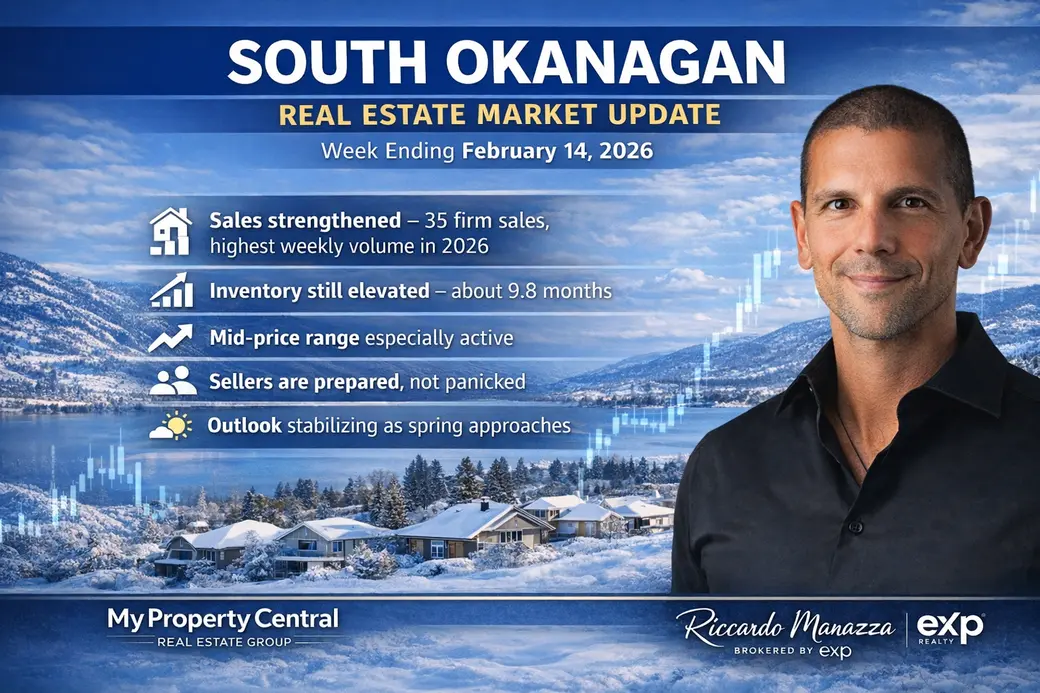
With 35 firm sales this week — one of the strongest weekly totals of the year so far — and months of inventory dipping below 10 for the first time in weeks, the data is telling a consistent story: buyers are coming off the sidelines, slowly but steadily. In this week's update, I'll break down what's happening locally, how it fits within the broader national and provincial picture, and what it all means if you're thinking about making a move.
Let's look at the numbers — and more importantly, what they actually mean for you
- 35 firm sales this week — one of the strongest of 2026
- Months of inventory dropped to 9.8, down from near 14 in prior weeks
- Average sale price: $589,525 | Average DOM: 96 days
- CMHC forecasts national sales below historical averages but improving through 2026
- BC recorded its second-weakest January since 2016 — but BCREA expects a 12% rise in sales this year
- Mid-price range and entry-level segments showing the most buyer activity locally
National Real Estate Context: CMHC's 2026 Outlook
Canada's national housing agency released its 2026 Housing Market Outlook this week, and the headline message is measured: expect subdued conditions, with gradual improvement over the year. CMHC projects 489,000 home sales nationally at an average price of $698,000 — up modestly from the 470,000 sales and $680,000 average seen in 2025.
The broader economic backdrop remains challenging. CMHC projects real GDP growth of just 0.7% for 2026 — one of the weakest non-recession years in recent decades. Trade uncertainty stemming from ongoing U.S. tariffs, elevated unemployment, and modest income growth continue to weigh on household confidence and spending. Housing starts are forecast to decline to 247,000 units, down from 259,000 in 2025, as developers face higher costs and weaker demand.
Importantly for our region, CMHC expects the pickup in housing demand to be led by Ontario and British Columbia, where markets are expected to rebound after some of their weakest sales in decades. The rental sector continues to show resilience nationally, suggesting diversified housing demand that could eventually flow back into ownership markets.
The key takeaway? National conditions suggest caution — not contraction. Recovery is happening, just slowly. The question is how that translates to our local market.
▲ Back to Key TakeawaysBritish Columbia: Slow Start, But Recovery Expected
The British Columbia Real Estate Association (BCREA) reported that just 3,314 residential sales were recorded across the province in January 2026 — down 22.9% from January 2025 and 30.97% below the 10-year average. The average MLS® residential price in BC dipped 1.9% year-over-year to $924,239. BCREA's chief economist described it as the province's second-weakest January since 2016.
Active listings have climbed to 32,626 units across BC — a 5.6% increase from last year. More supply combined with slower demand means buyers in most BC markets currently have more leverage than at any point in recent memory.
However, the outlook isn't all cautionary. BCREA's own Q1 2026 forecast projects a 12% increase in provincial sales this year, reaching approximately 78,690 units. Mortgage rates are expected to remain steady, and there is significant pent-up demand from over two years of below-average activity. The expectation is that as economic uncertainty stabilizes, buyers will gradually return.
BC overall is slower — but the South Okanagan may be showing early signs of divergence from the provincial trend.
▲ Back to Key TakeawaysSouth Okanagan Weekly Data Breakdown
| Metric | This Week (Feb 14) | Key Insight |
|---|---|---|
| New Listings | 102 | Steady flow of new supply entering the market |
| Price Changes | 34 | Sellers adjusting — mostly in upper brackets |
| Conditional Sales | 1 | Most sales moving directly to firm status |
| Firm Sales | 35 | One of the strongest weeks of 2026 so far |
| Off Market | 31 | Expired or withdrawn listings being removed |
| Active Inventory | 1,482 | Elevated, but absorption is improving |
| Months of Inventory | 9.8 | Down from ~14 earlier — significant improvement |
| Avg. Sale Price | $589,525 | Stable — no sharp movement up or down |
| Avg. Days on Market | 96 | Declining slightly as buyer activity increases |
The standout data point this week is the 35 firm sales combined with months of inventory dropping below 10. Earlier in 2026, we were tracking closer to 14 months — a level that signalled a heavy buyer's market. At 9.8, we're still in buyer-favouring territory, but the trend line is moving toward balance. Average days on market at 96 suggests homes are still taking time to sell, but that number has been ticking down — another sign of gradually improving demand.
▲ Back to Key TakeawaysCore Market Themes This Week
Sales Activity Trending Up. Buyers are stepping off the sidelines. Increased showings, particularly in the mid-price range, are translating into actual offers and firm deals. The apartment and entry-level segments are seeing the most traction right now, which often signals the beginning of broader market engagement — first-time buyers and downsizers tend to move first.
Inventory Still Elevated — But Stabilizing. With nearly 1,500 active listings, sellers still face competition for buyer attention. However, the pace at which listings are being absorbed has improved meaningfully. Lower listing levels in some price bands suggest that while the overall number looks large, certain segments are tightening. This is not uniform softness — it's a market of micro-conditions.
Seller Psychology: Informed, Not Panicked. One of the themes I keep seeing is how well-informed today's sellers are. Many are following weekly market data — including these updates — and making strategic decisions rather than reactive ones. They're not rushing to cut prices. They're watching the data, holding where they can, and adjusting only when the evidence supports it. That patience is actually healthy for the broader market.
Limited Pricing Pressure. Despite elevated inventory, we are not seeing significant downward pricing pressure, particularly in the entry-level and mid-range segments. Upper-bracket properties have seen some price reductions, but overall, sellers are holding firm. The average sale price of $589,525 remains stable week over week.
▲ Back to Key TakeawaysOn-the-Ground Observations
Beyond the data tables, there are real-time signals that matter. Open house traffic this week has been a notable indicator — not record-breaking attendance, but consistent, intentional foot traffic. These aren't casual browsers; they're people who have done their homework online and are ready to see properties in person. That's a meaningful shift from the tire-kicking we saw earlier in January.
The Family Day long weekend will likely create a brief pause in momentum, which is normal. Families are focused on the holiday, not house hunting. But the timing is worth watching — this is the unofficial start of the spring real estate season in the South Okanagan. The first open houses of the year are happening right now, and the buyer engagement we're seeing at those events will serve as a barometer for what March and April could look like.
This market is not about hype or headlines — it's about clarity. The data this week tells a simple story: buyers are returning, sellers are prepared, and the South Okanagan is finding its balance heading into spring.
There's also a psychological element at play. Buyers who have been watching from the sidelines are starting to accept that current conditions — elevated inventory, stable-to-steady pricing, competitive mortgage rates — represent an opportunity rather than a warning. Mortgage rate normalization has helped. When rates aren't swinging wildly, people can plan with more confidence. That clarity is a confidence driver.
▲ Back to Key TakeawaysWhat This Means for Sellers
Strategic positioning matters more than ever. With nearly 1,500 homes on the market, differentiation is critical. Buyers have options, and the homes that sell fastest are the ones priced accurately from day one, presented well, and marketed effectively. Early pricing precision reduces the risk of sitting on the market for months — and once a listing exceeds 90+ DOM, it can signal to buyers that something is wrong, even if the home itself is great.
Use open house traffic as a leading indicator. If you're not getting showings in the first two weeks, that's a pricing signal. Stronger sales weeks like this one favour prepared sellers — those who are ready to move quickly when the right offer comes. Don't wait for a correction that may not come. The market is telling you what it wants through traffic patterns and showing feedback.
The 34 price changes recorded this week show that some sellers are adjusting, but most of these are concentrated in the upper brackets. If you're in the mid-range and priced right, the current environment is actually working in your favour as buyer activity concentrates in that segment.
▲ Back to Key TakeawaysWhat This Means for Buyers
You have more selection than at any point in recent years. With 1,482 active listings, particularly strong inventory in the detached and townhouse segments, buyers have real choice. That's a significant advantage — one that won't last forever if absorption rates continue to improve.
Negotiation room still exists, but competition is building. The mid-price range is heating up. I'm seeing more multiple-inquiry scenarios in the $400,000 to $650,000 bracket — not bidding wars, but enough interest that well-priced homes are moving. If you're a buyer in this range, being pre-approved and prepared to act makes a real difference. The days of casually touring for months and then making an offer are giving way to a more intentional market.
Mortgage rates remain competitive by historical standards, and the expectation is that they'll stay relatively steady through 2026. If you've been waiting for a clear signal to start your search, this week's data — improving absorption, stable prices, plenty of inventory — is about as clear as it gets.
▲ Back to Key TakeawaysForward-Looking Outlook
Short-Term (Next 2–4 Weeks): The data to watch over the coming weeks includes open house attendance, new listing volume, and whether this week's 35-sale pace can repeat or improve. If absorption holds, we could see months of inventory drop further toward the 8–9 range, which would represent a meaningful shift toward balance.
Spring Setup: If the current momentum continues through February and into March, the market transitions from "buyer-heavy" to "balanced." That's not a seller's market — it's an environment where well-priced homes sell in a reasonable timeframe and buyers still have selection. If sales slow again, inventory pressure returns and the window for sellers narrows. The next month will be telling.
On the national front, CMHC's expectation of gradual recovery through 2026 — led by BC and Ontario — aligns with what we're seeing on the ground here. The South Okanagan isn't immune to national headwinds, but our weekly data suggests we may be slightly ahead of the provincial curve in terms of buyer re-engagement.
▲ Back to Key TakeawaysThe Bottom Line
The South Okanagan real estate market is not overheating. It is not weakening. It is stabilizing — with improving buyer participation and a data trend that points toward balance as spring approaches. This is a transitional phase, and the decisions made now, by both buyers and sellers, will shape how the rest of 2026 unfolds.
If you're watching this market, keep watching. If you're ready to act, the data supports it. And if you want to talk through what these numbers mean for your specific situation — whether you're buying, selling, or simply curious — I'm here for that conversation.
Clarity over hype. Strategy over speculation. Data-backed local insight.
Frequently Asked Questions
How many homes sold in the South Okanagan this week?
There were 35 firm sales recorded for the week ending February 14, 2026 — one of the strongest weekly totals so far this year, signalling improving buyer engagement across the region.
What is the months of inventory in the South Okanagan right now?
Months of inventory currently sits at 9.8, which is a significant improvement from earlier weeks in 2026 when it was closer to 14. While still a buyer-favouring market, the trend is moving toward balance.
Is it a good time to buy a home in Penticton or the South Okanagan?
Buyers currently enjoy more selection than in recent years, with nearly 1,500 active listings. Mortgage rates are competitive by historical standards and negotiation room remains. However, mid-range competition is increasing, so getting pre-approved and being prepared to act is key.
Are home prices dropping in the South Okanagan?
There is no significant downward pricing pressure at this time. Entry-level and mid-range segments remain relatively stable. Some upper-bracket properties have seen reductions, but the average sale price of $589,525 is holding steady.
What is the average days on market in the South Okanagan?
The average days on market is 96. While still elevated, this figure has been declining slightly in recent weeks as buyer activity picks up — a positive sign for sellers who are priced correctly.
What does the CMHC forecast mean for the Okanagan?
CMHC projects national sales will remain below historical averages with GDP growth of just 0.7% in 2026. However, BC is expected to lead the recovery nationally, which could benefit the South Okanagan as buyer confidence returns and pent-up demand is released.
Should I sell now or wait for spring?
The early spring window may offer better positioning than waiting until peak season, when more competing listings typically arrive. Buyer activity is strengthening now, and sellers who price accurately from day one are best positioned to benefit from this momentum.
How does the South Okanagan compare to the rest of BC?
BC recorded its second-weakest January since 2016 with sales down 22.9% year-over-year. The South Okanagan is following a similar trend but showing early signs of divergence, with weekly sales strengthening and absorption improving faster than many provincial benchmarks.
Whether you're watching the market or ready to make a move, I'm here to help you navigate with clarity and confidence. Let's talk about what this data means for your situation.
Ready to Connect?- CMHC — 2026 Housing Market Outlook
- BCREA — 2026 Kicks Off With Weak Sales Activity (Jan 2026 Statistics)
- BCREA — Q1 2026 Housing Forecast Update
- South Okanagan MLS® weekly data — Riccardo Manazza, eXp Realty

Categories
- All Blogs (76)
- Buyer Guidance (3)
- Buyer Guides (2)
- Buyer Resources (1)
- Buying Tips (3)
- Canadian Real estate Trends (3)
- Construction & Material Costs (2)
- Contracts & Consumer Protection (1)
- Downsizing (1)
- Economic Insights (2)
- Estate Planning & Finance (1)
- Featured Listings (2)
- Financial Education (1)
- Financial Planning for Homebuyers (2)
- First time Buyer Advice (4)
- Home buying advice (7)
- Home Buying Guides (3)
- Home Selling Strategies & Market Insights (1)
- Home Selling Tips & Market Insights (1)
- Homeowner Advice (3)
- Homeownership Tips (1)
- Housing Market Analysis (1)
- Interest Rates & Financing (1)
- Investment & Lifestyle Real Estate (1)
- Investment Strategies (2)
- Legal & Probate Guidance (1)
- Listings in Oliver (1)
- Market Trends (1)
- Market Education (1)
- Market Updates (15)
- Mortage & Financing (2)
- Mortage Strategies (2)
- Okanagan Lifestyle & Local Guides (2)
- Osoyoos Real Estate (3)
- Penticton & Okanagan Housing Market Analysis (1)
- Penticton Real Estate (4)
- Pet-Friendly Homes (1)
- Probate & Estate Real Estate (1)
- Probate Real Estate (1)
- Real Estate Business & Motivation (1)
- Real Estate Career & Client Education (1)
- Real Estate Career & Motivation (2)
- Real Estate Career Insights (1)
- Real Estate Education (1)
- Real Estate Financing & Investment (1)
- Real Estate Guides (3)
- Real Estate Insights & Guides (3)
- Real Estate Investment & Market Insights (1)
- Real Estate Investment Analysis (1)
- Real Estate Investment Strategies (1)
- Real estate Market insights (1)
- Real Estate Market Updates (1)
- Real Estate Tips (5)
- Real Estate Trends (1)
- Remember to Create (1)
- Seller Guides (1)
- Seller Resources (1)
- Seller Tips (1)
- Selling Tips (2)
- South Okanagan Insights (1)
- South Okanagan Listings (1)
- South Okanagan Market Reports (2)
- South Okanagan Market Update (4)
- South Okanagan Real estate (11)
- South Okanagan Real Estate Investing (3)
- South Okanagan Real Estate Market (2)
- Sustainable Real Estate Investing (1)
- Townhouse Oliver (1)
Recent Posts